
THE KINGTALII PEPPER ARCHIVE
RB003 Pepper History & Genetics: Ross Barber Origin Story

Archive note: This entry is about giving the pepper and its breeder the proper credit while separating what can actually be documented from what has simply been repeated online.
RB003: A Pepper With a Bigger Reputation Than Paper Trail
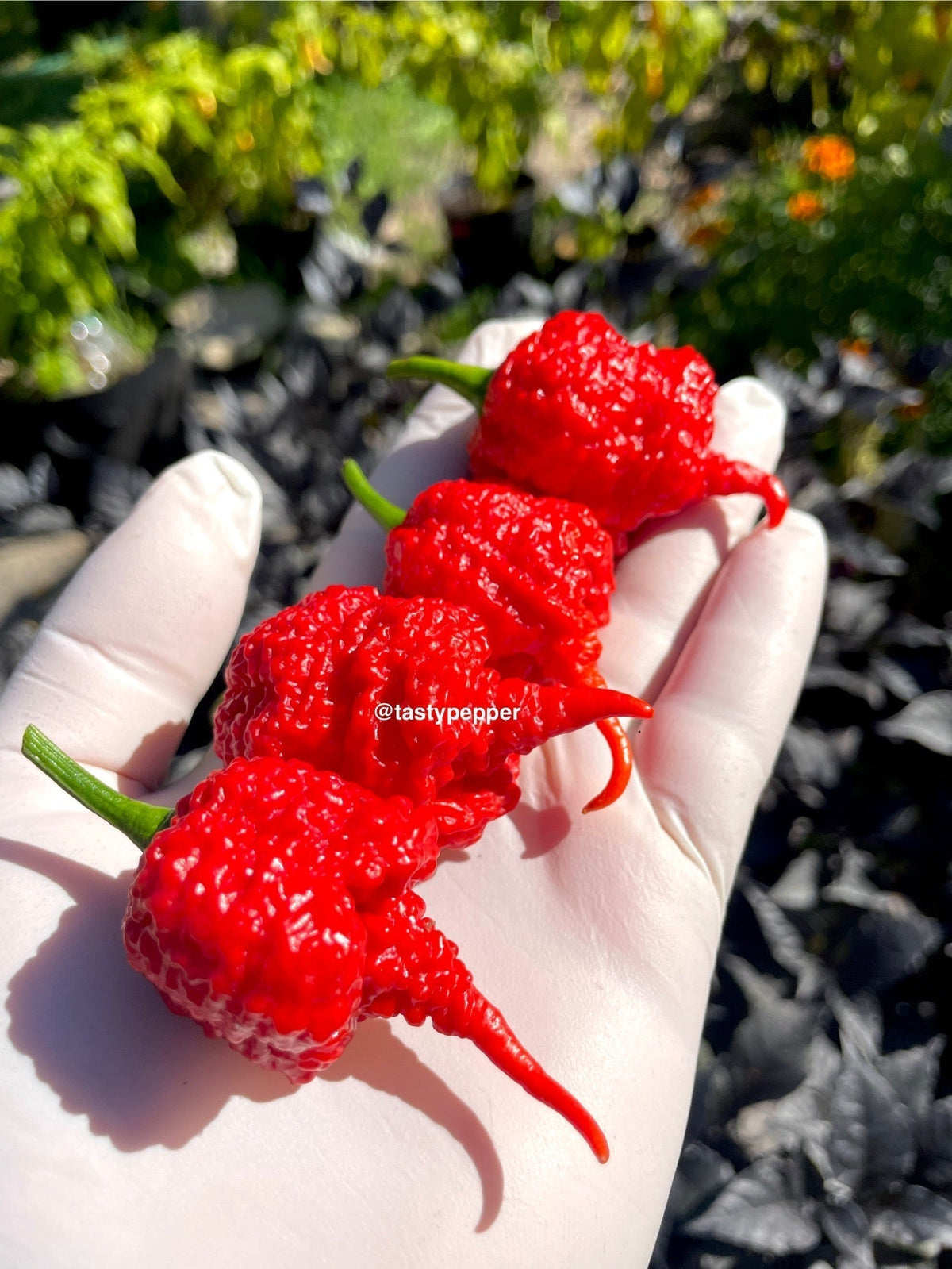
If you spend enough time around rare super-hots, eventually you run into RB003. The pods look wild: rough, folded, twisted, heavily textured and sometimes carrying a sharp tail. It is the kind of pepper that makes growers stop scrolling and ask, “What is that?”

But once I started digging into the history, I noticed something important. RB003 is well known inside the pepper-growing community, yet there is surprisingly little formal documentation about it. There is no Guinness record page for RB003, no university release paper, no published cultivar registration that I could locate, and no widely cited scientific paper documenting the original cross. Most of its history survived the old-fashioned pepper-community way: breeder notes, seed exchanges, grow logs, forums, social media and growers passing the genetics forward.
That does not mean the history is unknowable. It means we have to be careful about separating documented attribution from community-repeated claims.
Who Created RB003?
The breeder consistently credited with creating RB003 is Ross Barber of Queensland, Australia. Multiple independent pepper sources identify Barber as the creator of RB003 and the larger RB series. The “RB” designation is reported to come from his initials. SpiceQuest’s breeder profile identifies Barber as an Australian hobby breeder behind the RB series, while multiple grower and seed sources independently repeat the same attribution.
I could not locate a dedicated breeder-owned website or a Wikipedia biography for Ross Barber during this research. The most direct breeder presence I found referenced by growers is his social account, Ross Barber / Phenos and Crosses on Instagram. An independent breeder profile is also available from SpiceQuest’s Ross Barber profile.
That credit matters. Rare pepper genetics have a bad habit of becoming disconnected from the people who actually made the crosses once seeds move through enough hands. The Kingtalii Pepper Archive is not going to erase the breeder just because a pepper became popular.

What Does RB003 Mean?
Sources describing Barber’s breeding work say RB is his initials and that numbered RB lines represent different experimental crosses in his breeding program. RB003 became the best-known of those numbered lines. That naming system also explains why “RB003” should be treated as a breeder designation, not a generic name for any ugly red superhot that resembles it.
The Reported RB003 Lineage
The broad lineage repeated across the pepper community is Carolina Reaper × 7 Pot Brain Strain. More specific accounts describe the original cross as Yellow Reaper × Red 7 Pot Brain Strain. Harmony Springs Farm reports the latter formulation and identifies the Yellow Reaper as the fruit parent and Red Brain Strain as the pollen parent. A 2023 r/HotPeppers discussion from a grower who said their seed came directly from Ross Barber also describes RB003 as a 7 Pot Brain Strain × Yellow Reaper cross.
Because I have not located a surviving breeder-authored primary document laying out the original cross generation by generation, I am treating Yellow Reaper × Red 7 Pot Brain Strain as the best-supported reported lineage, not rewriting it as a laboratory-verified pedigree.
The Reaper Side of the Family

The Carolina Reaper brings a documented superhot pedigree to the story. Guinness World Records recognized Smokin’ Ed Currie’s Carolina Reaper in 2013 at an average of 1,569,300 Scoville Heat Units. Guinness also reported that Currie spent years stabilizing and testing the line. That matters when looking at RB003 because one side of its reported family tree comes from a pepper already selected intensely for extreme pungency and distinctive pod structure.
One caution: the term “Yellow Reaper” can describe a yellow-fruited Reaper-type selection, but I have not found an authoritative primary record proving exactly which Yellow Reaper seed line Barber used. That detail should remain part of the reported history rather than being embellished.
The 7 Pot Brain Strain Side
The other reported parent is the 7 Pot Brain Strain, a brutally hot Capsicum chinense type associated with David “Cappy” Cappiello and selected for the folded, brain-like pod morphology that gave the line its name. Established pepper-community documentation places Brain Strain development in the late 2000s.
When you look at RB003, the combination makes visual sense: Reaper-type tails and extreme heat mixed with the deeply folded, contorted surface associated with Brain Strain genetics. But appearance alone cannot prove pedigree. That is exactly why breeder attribution and historical records matter.
What Species Is RB003?
RB003 is generally grown and cataloged as Capsicum chinense, the same domesticated Capsicum species that includes many habaneros, 7 Pots, Reaper-type peppers and other superhots. Scientific research on C. chinense shows enormous genetic variation in pungency, carotenoid content and fruit chemistry, which helps explain why crosses between extreme lines can continue throwing interesting traits through later generations.

How Hot Is RB003 Really?
This is where I want the Archive to be stricter than a seed listing.
You will see RB003 advertised online at roughly 750,000 SHU, 1.5 million SHU, 2 million SHU and sometimes even higher. Those numbers cannot all be treated as an official measurement of the variety. I did not find a published, controlled HPLC test establishing a definitive RB003 Scoville rating.
Modern pungency testing uses analytical methods such as high-performance liquid chromatography (HPLC) to quantify capsaicinoids. NIST explains why HPLC is more reproducible than the old sensory dilution method behind the original Scoville test. Until a traceable RB003 sample is tested under controlled conditions and the methodology is published, I would rather describe it accurately as an extreme superhot than pretend an internet estimate is an official number.
That is especially important because pepper heat is not fixed like a serial number. Environment, genetics and growing conditions can affect capsaicinoid expression. Scientific work on Capsicum chinense also shows substantial variation in capsaicinoid content among germplasm and identifies multiple genetic factors associated with extreme pungency.
Why RB003 Looks So Mean
The classic RB003 phenotype is usually described as elongated to irregular, heavily wrinkled or blistered, twisted, red at maturity and often tailed. Different grow-outs can show variation, which is not unusual for complex hybrid material—especially when growers are working from different seed sources or generations.
That variation is part of why provenance matters. A pod that looks different does not automatically mean somebody discovered a new pepper, and a pod that looks similar does not automatically make it RB003.
The Peach and Color-Variant Question
Some RB003 grow-outs have produced peach or other unusual color expressions. Harmony Springs discusses a peach phenotype appearing in later generations and raises legitimate questions about recessive color genetics and the completeness of the surviving pedigree story. I think the responsible position is simple: interesting color variants are worth documenting, but we should not invent a genetic explanation without breeder records or genetic testing.
Modern research confirms that fruit color and pungency in C. chinense are complex traits involving many genetic loci. That makes unexpected segregation biologically believable without giving us permission to guess exactly which allele came from where.
RB003 Is Not “The Beast”
Another point worth documenting is the occasional confusion between RB003 and peppers sold under Beast-type names. Similar pod texture is not evidence that two varieties are the same. RB003 has its own breeder attribution and reported Reaper × Brain Strain history. If a seller collapses every twisted Reaper-looking superhot into the same name, that destroys the exact history growers should be preserving.
My Kingtalii Connection to RB003

I came to RB003 as a grower and selector, not as its creator. I have grown a large population from RB003 material and watched for plants that separated themselves from the rest. That is where my own work begins.
When I find a plant with unusual foliage, pod color, growth habit or ripening behavior, I can document that phenotype, save seed, grow the next generation and see whether those traits repeat. If I eventually develop a distinct, stable Kingtalii selection from RB003-derived material, the right way to tell that story is to preserve both pieces of the lineage: Ross Barber created RB003; Kingtalii selected forward from RB003-derived genetics.
That distinction is important to me because pepper history gets messy fast when the original breeder disappears from the story.
Why RB003 Belongs in the Kingtalii Pepper Archive
RB003 represents a part of pepper history that does not always make it into formal records. Not every important pepper came out of a university program or a commercial seed company. Some came from hobby breeders making crosses at home, sharing seeds with other growers and letting the community carry the genetics around the world.
Ross Barber’s RB003 is one of those peppers.
It is also a reminder of why I started the Kingtalii Pepper Archive in the first place. If we do not document the breeder, the genetics, the competing claims and the things we still do not know, eventually the internet turns a complicated history into one sentence—and sometimes that sentence is wrong.
What I Consider Well Supported
- RB003 is credited to Australian hobby breeder Ross Barber of Queensland.
- The RB name is associated with Barber’s initials and his numbered breeding lines.
- The commonly reported lineage is Reaper × 7 Pot Brain Strain.
- The more specific reported pedigree is Yellow Reaper × Red 7 Pot Brain Strain.
- RB003 is a Capsicum chinense-type superhot with heavily contorted pods and severe heat.
- No authoritative published HPLC value for RB003 was located in this research, so precise SHU claims should be treated cautiously.
What Still Needs Better Documentation
- The exact date Barber made the original RB003 cross.
- A surviving breeder-authored generation-by-generation grow log.
- The exact provenance of the Yellow Reaper parent used in the cross.
- The filial generation at which the familiar red RB003 phenotype became reasonably consistent.
- A published laboratory HPLC analysis of authenticated RB003 fruit.
- Formal documentation of the earliest peach and other color segregations.
Sources & Further Reading
I checked more than ten sources while building this entry, including direct pepper-community records, breeder profiles, established grower documentation, Guinness records and peer-reviewed Capsicum research. The strongest sources are linked below. Where the sources disagree, I have left the disagreement visible instead of forcing a cleaner story than the evidence supports.
- SpiceQuest — Ross Barber breeder profile
- SpiceQuest — Comprehensive Pepper Catalog
- Harmony Springs Farm — RB003 history, lineage and grow observations
- Harmony Springs Farm — Yellow RB003 and segregation discussion
- r/HotPeppers — 2023 RB003 grower discussion, including direct-from-breeder seed provenance claim
- Mack’s Peppers — independent RB003 breeder and lineage attribution
- Guinness World Records — Carolina Reaper 2013 record documentation
- National Institute of Standards and Technology — measuring pepper heat and HPLC
- PubMed / Journal of Experimental Botany — genetic control and localization of pungency in C. chinense
- PubMed — genome-wide study of carotenoid and capsaicinoid traits in Capsicum chinense
- PubMed / New Phytologist — genetics underlying extreme pungency in peppers
- PubMed / Theoretical and Applied Genetics — capsaicinoid biosynthesis in C. chinense
Archive standard: This article will be updated if stronger primary documentation from Ross Barber, authenticated early grow logs, or laboratory heat data becomes available.
HELP BUILD THE RECORD
Know something we should add—or correct?
The Kingtalii Pepper Archive is a living record. Growers, breeders, seed keepers and people who were there can help make each story stronger. If you have a correction, firsthand history, original documentation, or photographs that belong in the record, send them for review.
See a date, breeder detail, lineage claim or historical point that needs another look? Tell us what should be corrected and, when possible, include the source.
Share firsthand grower or breeder knowledge, early seed sources, dates, selections, phenotype history or context that may be missing from the current record.
Contribute plant, pod, early-generation or historical images you own or have permission to share. Accepted contributions can be credited to you.
Community input is reviewed before it becomes part of the Archive. Claims may be labeled Verified, Breeder-Reported, Grower-Reported, Commonly Reported or Unresolved. A submission gives us evidence to investigate—it does not automatically become historical fact.
Please include the pepper name, what you know, how you know it, any dates or sources you have, and whether submitted photos are your own. By submitting a photo, you confirm you own it or have permission to share it for Archive review.